Franco Vaccari
Fuori Schema
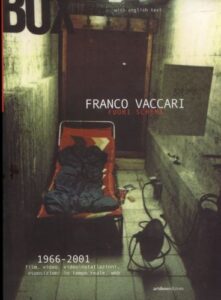
FRANCO VACCARI. FUORI SCHEMA. Film&Video 1966 – 2001
Art Show edizioni, 2001
a cura di Claudia Zanfi
Mostre:
- Photomatic e altre storie (Galleria Belvedere + Piazza Duomo, Milano – IT, Marzo – Maggio 2006)
- Going Public ’05 (Modena e Formigine – IT, Ottobre – Novembre 2005)
- International Film Festival (Locarno – CH, Agosto 2003)
- Museo Laboratorio, Università La Sapienza (Roma – IT, Maggio 2002)
- Galleria Civica di Modena (IT, Febbraio 2002)
- Via Farini (Milano – IT, Novembre – Dicembre 2001)
- CAREOF (Milano, Novembre – Dicembre 2001)
by Claudia Zanfi. Con testi di Franco Vaccari
Solo show, film and video events
- Franco Vaccari: film sperimentali (Libreria Rinascita, Modena, 1968)
- Experimentalni filmovi (Bitef, Galerija 2I2, Belgrado, 1968)
- Cinema italiano indipendente (Club nuovo teatro, Milano, 1969)
- Film di Gianfranco Brebbia, Sirio Luginbuhl, Franco Vaccari (Galleria Paolo Barozzi, Venezia, 1970)
- La placenta azzurra (Galleria Blu, Milano, 1970)
- TRIGON 73 (Neue Galerie am Landesmuseum, Graz, 1973)
- Nuovi media (Centro Documentazione e Ricerche Jabik, Centro Internazionale di Brera, Milano, 1974)
- Camel Award. Artevideo & Multivision (Rotonda della Besana, Milano, 1975)
- Rencontre internationale ouverte de video (CAYC, Buenos Aires, 1975)
- Cinema d’artista e Cinema sperimentale in Italia 1960-1978 (Parigi, 1975)
- Cine qua non, Giornate internazionali di Cinema d’Artista (Cappella di Santa Apollonia, Firenze, 1979)
- Camere incantate (Palazzo Reale, Milano, 1980)
- Soffici notti, rassegna di videoarte nel parco (Reggio Emilia, 1983)
- Memoria del video (PAC, Milano, 1988)
- Il cinema d’artista in Italia. Dagli anni Sessanta agli anni Ottanta (Palazzo delle Esposizioni, Roma, 1991)
- Cinema oggettivo (Museo d’Arte Contemporanea, Marsiglia, 1995)
- Pop videoart-videoazioni (Magazzini Generali, Milano, 1998)
- Gratta e vinci (Artforum Gallery, Merano, 1998)
- Arte video storica (Casa Furlan, Spilimbergo (PN), 1999)
- RE-PLAY. International Media Art in Osterreich (Generali Foundation, Vienna, 2000)
- Via Emilia (Corte Ospitale, Rubiera (RE), 2000)
- MoViE: Modena Video Eventi (Provincia di Modena, Modena, 2001)
- Fuori schema. Film, video, video installazioni, web 1966-2001 (Care of/Viafarini, Milano; Galleria Civica di Modena; Museo Laboratorio Universita La Sapienza di Roma)
- Fuori Schema. Film e Video 1966-2002 (Locarno, 56 Festival Internazionale del Film, 2003)
Underground
1966/67, 16 mm, transferred onto video, Black & White, 15′
From basements and lavatory walls, this graffiti is to be taken as a kind of anonymous poetry we sometimes come across.
The blue placenta
1968, 8 mm, transferred onto video, colour, sound, 10′
Through the montage of different television clips, we are shown the birth of the world out of an initial state of inarticulate chaos, the ensuing triumph of form and order, and lastly the destruction which leads back to the original state.
Windoscope
1969, 8 mm, transferred onto video, colour, sound (Silence out of order), 2′ 4”
Monuments are monumental because they are solid, still and untouched by the passing of time. However, it takes very little (a coloured paper streamer and a piece of chewing gum) to show that the wind, that is, time, is passing. Especially if the person who sticks the chewing gum to the monuments is a friend who is no longer with us.
Slow Dogs
1971, 8 mm, transferred onto video, Black & White and colour, soundtrack taken from “Atom Heart Mother” by Pink Floyd, 12′
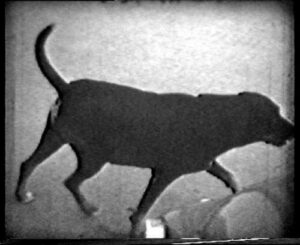
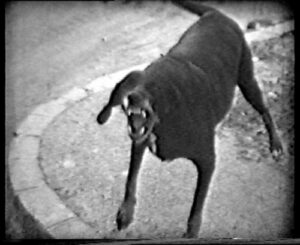
Stray dogs filmed in slow motion, interaction between the film camera and the dogs, who clearly feel observed. Observation is always perturbing for the subject.
Feedback
1972, 1/2 inch videotape, transferred onto video, Black & White, 12′
Two media made to interact: video and Polaroid.
(produced by Luciano Giaccari)
Experiment with time
1973, 1/2 inch videotape, transferred onto video, Black & White, 9′
Even the simplest of subjects, like a walnut moving on a white sheet of paper, does not allow us to memorise its movements. But if this nut is cracked, the moment then becomes irreversible; the direction of time’s arrow is clear. But if then, unexpectedly, a little worm crawls out of the cracked nut, the question becomes intensely complex because the worm carries its own sense of time which is not comparable to our own.
The electronic beggar (or “The means is power”)
1973, 1/2 inch videotape, transferred onto VHS, Black & White, sound by the artist
Continuous tape used for a video-installation. A man begging for alms is filmed before being replaced by a monitor showing a recording. On the screen appear the words “DER BLINDE KOMMT GLEICH” (The blind man will be back shortly).
Fragmented Film
1973/76, from pieces of 4-photo strips
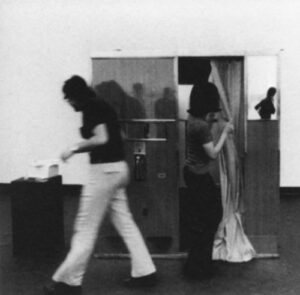
I had a poster put up in all the photo booths in Italy saying that I was looking for new faces for a coming film. The film was never made; the work consists of all of the passport-size photos that the aspiring actors left for me in the booths. This is a film made up of people who have only ever seen their own part of it.
Pylorus (Marilena double face)
1974, 8 mm, transferred onto video, colour, sound by the artist, 6′
I see a girl in the marketplace. I follow her. She stops to buy some fruit. She chooses a grape. The camera closes in on her mouth as she eats it and follows the grape down as far as the pylorus.
Via Emilia is an Airport
2000, VHS, Color, sound, 16′
Along the Via Emilia, immigrants watch television from their own countries. The prostitutes under the street lights think of their far away homes. The Emilians put aeroplanes in their front yards and dream of escaping.
(produced by Linea di Confine, Rubiera – RE)
Hunger for Wind
2001, Installation using video-projection, Synagogue of Trnava, Slovak Republic
After the Jewish community of Trnava disappeared in the Nazi concentration camps, the Synagogue has been used in the last few years to house exhibitions which up until now have been dedicated to the memory of the holocaust. I kept this in mind when planning my installation, but in the spirit of that strange book in the Bible called “Ecclesiastes” or “Quoelet”, which seems to deny all transcendence. As it says, “…and so all is empty nothingness, and a hunger for wind”. This is where I took the title Hunger for Wind from. In the preparation of the exhibition, several strange coincidences occurred. For example, it seemed to me to be almost a sign of destiny to find a photo from 1937 of the children of the Talmud school of Trnava. I had the photo blown up and put it up in the apse of the synagogue, while a video projector projected images of peacocks onto the floor. At night, a floodlight beam, one of those visible from miles away which are used to mark the presence of a night club, shone up into the clouds.
Debora’s Album
2002, VHS, Color, Sound
In conversazione con Claudia Zanfi
CZ – In 1966: “Esposizione Internazionale di Poesia Sperimentale” at the Casa del Mantenga in Mantua; “Poesia Visiva” at Feltrinelli bookshop in Milan; “La Lettura del Linguaggio Visivo” at Castello del Valentino of Turin. Your artistic career started off in the field of visual poetry. How did this come about?
FV – I initially studied sciences and graduated in physics. At the same time, I had a strong interest in the arts in general, but in poetry, photography and cinema in particular. In 1965 I had a book of my poetry printed up. It was then re-published the following year by the Sampietro editor, which was preparing an anthology of visual poetry. And so that is how my path came to cross that of the visual poets like the Florentine group made up of Miccini, Pignotti, Ori, Marcucci, Ketty La Rocca and Isgrò “the nomad”.
CZ – In the same year, your first film Nei Sotterranei (Underground) came out – a story told using 16mm film. Did you intend to start a parallel career in cinema?
FV – As I said before, I was interested in photography and I was also what you might call a film lover. Sampietro again published a book for me entitled Le Tracce (The Traces) which dealt with graffiti as a form of anonymous poetry, poetry to be discovered. The film Nei Sotterranei (Underground) was largely put together using that material. The Italian title reflects the English word ‘underground’ which was starting to circulate at that time. It is a typical word on the alternative culture scene; it’s the term which marked out the opposition to official culture and which helped set the scene for the events of ’68.
CZ – As far back as 1969 you took part in the “Cinema Italiano Indipendente” season at the Nuovo Teatro in Milan, while ten years later you were to be found at “Cine qua non” for the “Giornate Internazionali del Cinema” in Florence. What influence did these experiences have on you?
FV – The word ‘cinema’ used to describe those experiences is perhaps a bit too much. The films only lasted a few minutes, they were usually the only existing copy, and if the artist didn’t want to lose his film, he had to keep a constant eye on it. I nicknamed that type of cinema “films with director attached”. I lost three films myself there.
CZ – Some time later, in 1974 you took part in the “Rencontre International de Video” event in Buenos Aires, and in 1977 you attended the “Cinema d’Artista e Cinema Sperimentale in Italia” season in Paris. Did those experiences abroad give you the chance to meet other artists who understood the range of research projects that you were carrying out at the time? How did your career develop in the light of those events?
FV – My most meaningful experiences were those at Graz in Austria on the occasion of the “TRIGON 73”, which was one of the first exhibitions in Europe dedicated to video-art. Appollonio and Gillo Dorfles had organised the Italian component which was made up of Baruchello, Gianni Colombo, Agnetti, Patella and myself. There I met Richard Kriesche, Sanja Ivekovic, Dalibor Martinis, Valie Export and Peter Weibel, and I had the chance to see the video works of Bruce Nauman, Robert Morris, Baldessari, Keith Sonnier, William Wegman and, most importantly, Vito Acconci.
CZ – Again in 1974, you took part in the “Narrative Art” exhibition at the Galleria Cannaviello (which was based in Rome at the time). We could say that the sense of semantic incisiveness – be it writing, photography or cinematography – is one of the constant elements of your artistic research. Would you say that your concept of the work of art goes beyond conventional distinctions in favour of seeking a universal poetic language, a sort of narrative art?
FV – I could now say that there is a narrative tendency running through all my works, but this was recognised very early on in my career. In the two “Narrative Art” exhibitions at the Cannaviello in Rome, I was the only Italian artist present. Narrative Art marked the turning point between the cold, conceptual period and the warmer one which then blossomed into the post-modern experience.
CZ – What kind of relationship did you have at the time with artists such as Kosuth, Paolini, Isgrò and others who were already starting to work using a multi-faceted approach to art, exploring the word-object-action-meaning relationship?
FV – I was friends’ with Isgrò right from the moment in which I got interested in visual poetry. Paolini, undoubtedly one of the most interesting members of the “poveristi”, always belonged to a closed circle which did not try to make friends or to be made friends with by others. Why disturb this condition of self-sufficiency? There lies a philosophy behind every artist. Behind Kosuht there is an anglo-saxon one – logical empiricism – which he tends to absolutify, but which has been on the wane over the last few decades. I’m interested in other philosophies, ones rooted more in history or simply in life.
CZ – Let’s go back a moment to 1968/69. These years marked the start of a new, unprecedented project, revolutionary at the time, and a work which is still noteworthy today for its outstanding originality. We’re talking about the “Esposizioni in Tempo Reale” and the ‘technological sub-conscience’ which you explored from both a theoretical and practical point of view through an on-going series of projects ‘in real time’. How was this concept born? What kind of relationship did the project have with other cultural events of the time?
FV – The expressions in fashion at the time to indicate that an artistic experience was not closed in by a picture frame were installation, environment, action, happening, performance. The latter three, which are the ones that refer to an event, an occurrence, are characterised by their linear development. There’s a sort of framework to follow; only the most marginal aspects are ever left to chance. This makes it closer to theatre: Herman Nitch, for example, used the “Orgien – Mysterien Theater” formula for his own performances. Oldenburg and Kaprov, who coined the term ‘happening’, also worked in a similar direction. There was, however, a structurally new element to what I was doing. Instead of using a linear development, the trajectory altered continuously in merit of the degree of interaction with the participants. This novelty was allotted the term ‘feedback’ in reference to the retrospective effect which conditioned the very cause that generated it. In order for this to happen, the interaction needs to take place in ‘real time’. This is the origin of the name ‘Esposizione in Tempo Reale’, which I believe I ought to be credited with. As far as the other concept you mentioned is concerned, the ‘technological sub-conscience’, it’s very difficult for me to explain even in general terms. To do it any justice, I had to publish a book called “Fotografia e Inconscio Tecnologico” in 1979.
CZ – The technological sub-conscience debate seems to be anything but over – it continues to play a key role in current discussions. What is your impression of the huge quantity of photographic images which we are confronted with on a daily basis?
FV – There was a great turning point in the interpretation of the ‘photography’ phenomenon when Peirce’s semantic analysis, dating back to the beginning of the last century, was acknowledged. This analysis made it clear that photography is not so much an iconic as an indicative medium. In order to gather the immense importance of this interpretation, we would have to look at it alongside the concept of the ‘technological sub-conscience.’ One of the elements which characterises the contemporary era is that which we might call ‘hyper-production’ – an element whose meaning tends to pass us by completely. With reference to the images around us, we might say that this element leads us into a state of ‘perceptive bulimia’.
CZ – You were among the first Italian artists to undertake on-going research into means of artistic communication. What is your attitude towards the latest technological developments (Internet, Net Art, etc…) and their use in the field of contemporary art?
FV – Over the last 30 years, we have witnessed a rapid and on-going change in the media around us which has changed our habits of perception. There are two main issues to be dealt with in the light of these changes: the first is to do with using the new media adequately and fruitfully, and the second is about realising that these media can cause imperceptible changes to our view of the established media.
CZ – What is your attitude to young contemporary artists who use video images as a means of communication? And with regard to great artists such as Bill Viola, Gary Hill, Shrin Neshat, who have obtained outstanding results through their use of video, preferring it in fact to all other means?
FV – That’s true, they prefer using video to all other media. Italy is a country like a noodle: it’s long and thin. Opting to specialise in a single medium is possible only in ‘squarer’ countries where the artist has more space in all directions like in the United States or in Germany.
CZ – “Proletarismo e Dittatura della Poesia” in 1971 and “La Pratica Politica” in 1979 are both works rooted in a specific political standing. What was your role in the political and social events of 1968/69?
FV – Luckily, given my age at the time, I was largely unaffected by the events of ’68. Had I been younger, I probably would have got involved. My interest in politics dates back to before those years.
CZ – Your social interest can also be seen in your work dedicated to the liberation of Silvia Baraldini. Can you tell us about it?
FV – I’ve always been shocked by the underlying tendency over the last few years to close off art in a privileged world where it is allowed to judge others without being judged itself. In other words, a world where the risks are minimal because its values are established beforehand and then withdrawn from the debate. When I put the ‘Baraldini case’ at the centre of my work at the Biennale of Venice in 1993, it was with the intention of getting out of the suffocating artistic circles in order to make contact with a wider sense of reality, with fewer guarantees but more truths. Apart from this, my contribution to the resolution of the case consisted in showing that placing it at the centre of a piece of art drastically changed the way in which it was perceived from outside. As I said at the time, “If Silvia Baraldini had declared that there was an aesthetic meaning behind her actions, she would have ended up on the front page of Artforum rather than in prison.”
CZ – What does Franco Vaccari have to say in view of the events of the last few months – from the repercussions of the G8 meeting in Genoa to the collapse of the Twin Towers in New York?
FV – The twentieth century started with the pistol shot in Sarajevo and ended definitively on the 11th September 2001 with the big crash of the Twin Towers in New York. At Genoa, we had a foretaste of the climate that had been building up. Tornadoes are created when the atmosphere is saturated with energy and there are extremely polarised atmospheric conditions: a perfectly comparable situation to that which led to the attack on New York. Now it becomes clear that the West has gone too far in a state of arrogant blindness which has stopped it seeing what a state both itself and the Other are in. And art over the last few years, for how it has been organised and for what it has come up with, is a rather disconcerting example of this arrogance, presumption, and narcissistic uselessness which has characterised our world. Just think of the unbearable performance at the Palazzo Ducale of Genoa at the G8. The same thing can happen to art as what happened to the ‘space shield’, which fell apart like the towers all because of a few cutter-knives.
CZ – Which is for you the role of artists and intellectuals today facing the actual conflicts?
FV – If the artists and intellectuals simply managed to stay awake that would already be something.
CZ – What freedom of expression is left to be found, what videos are there still to be made after the images broadcast around the world of the collapse of one of the greatest symbols of the western world: the towers of the World Trade Center?
FV – From the narrow point of view of contemporary art, we might say that as far as video art, behaviourism, conceptualism, body art, etc. the attack on the World Trade Center was about as far as you can go. On the ‘spectacularity’ level, there’s nothing to compare to it, but we’re all sick to the back teeth of spectacular art. Ipervisibility can be a form of blindeness.
CZ – Let us go back to your film works. In 1971 you shot Cani Lenti (Slow dogs), a story of stray dogs, filmed with a heavily stressed slo-mo effect. The camera travels at dog’s eye-level along streets and alleyways, and the soundtrack is taken from a wonderful piece by Pink Floyd. What is the meaning behind this so carefully constructed work?
FV – It’s a constant feature in what I do that I try to reach my goals with a bare minimum of effort and using the most elementary means possible. I’ve never been very interested in special effects, and in this sense, I suppose I am a minimalist. I use ‘slo-mo’ in order to penetrate certain phenomena, to keep comprehension in line with perception. I think it ought to be made clear that the ‘film’ you’re talking about was made back in 1971, while the use of ‘slo-mo’ in video started to spread after Bill Viola used it for his “The Greeting” which we all saw at the Venice Biennale in 1995.
CZ – In 1968 you created La Placenta Azzurra (The blu placenta), with images taken from television. We find ourselves faced with a ‘televisual sub-conscience’ in which the entire story is made up of frames taken from television, de-contextualised and re-edited together. What were your points of reference for this work?
FV – Actually, when I was using the film camera, I concentrated on the parts of the transmission which the producers seemed to have lost control of, giving them a somewhat subliminal nature. But more than the film itself, I think that it was the title which was most effective. By “The Blue Placenta” I meant that we are all sort of connected by an umbilical cord to the television which constitutes our collective perceptive horizon. The blue was because, at the time, television broadcasts were in black & white or rather a kind of light blue.
CZ – Feedback and Esperimento col Tempo (1972 and 1973 respectively) both deal with one of the themes which is most dear to you: the relationship between time and the artistic event, or rather, the effect of the ‘counter-reaction’. What attitude ought an artist assume with regard to the relationship between time, memory and their representation?
FV – That’s a pretty hefty question! You’ll have to give me some time to think over that one.
CZ – Il Mendicante eletronico (The Electronic Beggar) (1973) represents a kind of ‘performance art film’. You filmed a man begging for alms who is subsequently replaced by a monitor showing a hand and a hat and a sign saying “The blind man will be back shortly”. Here the play-on-roles between fiction/reality/mis en scene is multiplied. As often happens in your work, you are the director who creates a meta-reality in which the audience is itself required to participate. In this case (and in general in the “Esposizioni in tempo reale”), how important is your passion for theatre?
FV – As I was putting together the material for this publication, I realised that I had experimented with the medium of television in all possible areas. Unlike cinema, where decent results have to be laboured for and where the editing process is based around a kind of ‘structure’, with video the biggest risk is that of wasting time. If you record for an hour, you need another hour to view the material you’ve shot, then you watch it again and another hour has gone by. If you then think back to the fashion in those years of producing long tedious videos, you will understand why I quickly lost interest in video art, which churned out all those tapes suitable only for inducing advanced states of narcolepsy. I used this medium to create some video installations, one of which was of course Il Mendicante Elettronico (The Electronic Beggar). If there was anything that made you think of theatre, it was perhaps due to the atmosphere created by shows like those of the Living Theatre or Kantor.
CZ – What are your points of reference in the visual arts and in cinema? Are there any artists towards whom you feel in debt?
FV – It’s difficult for me to list them; however, I would like to acknowledge my debt to Rossellini. But perhaps ‘debt’ is not the right word, as it gives the idea of there being some sort of link between our respective works which I wouldn’t dream of making. It’s Rossellini the man himself that fascinates me. He has the manner of a truly mature man, and that is something that you don’t come across so often nowadays where laddishness is so widespead, a childishness which lacks even the grace of innocence. One has the impression that he feels artistic circles are getting uncomfortably tight for him, as if they were no longer becoming of a man of his years. I like his impatience which is his love for the essence of things, his evident annoyance in the face of unwarranted poetry or the unwanted baggage of artistic mythology. Despite being an artist who makes so few concessions to ‘spectacularity’ as to seem bone dry at times, I feel that the sentiment underlying all his works is a closely guarded tenderness, which is a thousand miles from the current taste for excessiveness and cruelty.
CZ – La Via Emilia è un Aeroporto, your latest video experiment, deals with themes of great contemporary relevance: the multicultural and multiethnic society. However, at the same time, you bring out certain elements which thread together all your various artistic experiences: your liking for ‘suspended’ spaces like stations, airports, hotels, motorways. Do you feel like a bit of a nomad yourself? Is this not perhaps a necessary condition of the artist?
FV – I’m pleased you use the term ‘suspended spaces’ rather than the over-pumped ‘non-spaces’. To be more precise, I myself have started using the term ‘suspended identity spaces’ because the people who go there experience their own identity weakening and, at the same time, the temptation to take on other identities. Freedom and flexibility. A bit like a hermit-crab uncovering its abdomen as it passes from one shell to another. I believe that the artist places himself in similar situations: he accepts his own deconstruction so as to be able to rebuild himself all over again.
CZ – The theme of the journey (inner or not) can be found in many of your works. In your videos it turns up in the road sequences, the long voyages, the passages from one place to another. How do you yourself live the notion of the journey? Where in the world fascinates you the most?
FV – I’m not interested in the journey from a symbolic point of view, but as a powerful device to be used to activate reality, to invigorate chance. I have used travel as a way to escape from getting too blocked up with particular projects and as a way to give them shape. You asked me what places in the world fascinate me. Please bear in mind that my journeys have all taken place over short distances, and never in particularly well-known locations. I feel as if distance had lost all the seductive quality it once had and that it is no longer really possible to think about wandering around the globe as if it were also some kind of pilgrimage. Mine are ‘minimal journeys’; perhaps I will let you down if I don’t talk about India, Patagonia, Iceland or High Egypt. But by cutting down spaces, I wanted to highlight what might seem insignificant details: real movements which share common ground with the notion of sacrifices. The sacrifice – which derives from ‘sacrum facere’ – is the action which allows us to pass from the virtual to the real. Another aspect of the choice of the journey as a medium is the fact that it obliges us to get out of the art galleries which are now pervaded more than anything by a sense of suffocation.
CZ – Three years ago you dedicated yourself to what was a totally new kind of experiment for your work: the Atelier d’Artista (Artist‘s Atelier) CD rom. How did this project originate?
FV – I was supposed to put on an exhibition at the Casa del Giorgione in Castelfranco Veneto so I decided to turn it into the house of artists from around the world. I was only able to do this thanks to the help of a group of specialists in the new techniques of communication like the Internet. Thus, a few months before the date of the exhibition, a request for information on artists’ ateliers was posted on the net. There were hundreds of answers. All of the material collected was viewable at the exhibition, projected onto the wall. More and more material came in throughout the exhibition, at the end of which it was all saved for posterity on a CD/ROM.
CZ – Most of your work takes the form of interaction with the audience, and your work develops and grows on the basis of putting together your ideas and people’s responses to them. You seem to treat the Internet as a tool which lets you explore vast horizons but with a sense almost of amusement. Your desire to escape from artistic pigeon-holes, from the forms which constitute the parts of a particular style belies an approach of great creative freedom which reflects the trends of art today. What exactly is your attitude towards the present generation of artists? Do you feel that there is space for a fruitful dialogue between them and your own work, or do you feel that your generation is light years away from the present one?
FV – For the first time in my artistic career I feel that my work is not only understood but also studied. I’m given this feeling especially by the young generation like yourself. I have always been curious of other people’s work because it gives me the chance to leave behind the personal obsessions which are part of every artist.
CZ – In all your multi-faceted research, the underlying intention might be said to be that of countering the shift towards mass standardisation, with all its codes and rules. What are your future plans?
FV – In order to check how a plant is growing, it does no good to constantly pull it out of the ground to see what state the roots are in. There are things which have to take shape in the darkness, and one’s plans are among these.
(September 2001)
Franco Vaccari’s important film and video productions have recently resurfaced. Franco Vaccari is one of the leading Italian video artists, present some four times at the Venice Biennial with his one-man shows dedicated to his famous Esposizioni in tempo reale (“Real-time exhibitions”). The event, Franco Vaccari. Film e video 1966-2002, curated by Claudia Zanfi, is produced by the cultural workshop aMAZE in collaboration with the video library CareOF of Milan.
Among the works which draw on a wide-ranging contamination of the cinematographic language, and of both 1970’s conceptual research and various shooting techniques, the following films will be on show: Nei sotterranei (1966/67, 16 mm, 7 minutes) tells of the world of graffiti seen as a form of anonymous poetry, the poetry of the wall, of the street.
In La placenta azzurra (colore, 8mm, 7 minutes), which dates back to 1968, in the absence of a video recorder, the artist films the television. The title refers to the videosphere which envelops us all like an enormous placenta. This is a film on the means in which its editing plays a fundamental role. Film and video are extremely malleable materials through which one can create a vast range of things. In La placenta azzurra we are shown the various states of the world which starts with an initial state of chaos before taking on a form which is only to disintegrate at the same rate at which it was created.
Ventoscopio (16 mm) shows the visualisation of the wind, a sort of make-shift monument to time passing made with chewing-gum and a piece of paper. A person who has passed through time next to a monument which has resisted the passage of time, unchanged.
In 1972 he made Feed-back, in which he makes use of two different media: video and polaroid. The concept is avant-garde – no one else had started to examine the notion of “feed-back”, while Vaccari had already done so for a number of years with his Esposizioni in tempo reale.
The year before he made I cani lenti (8 mm, black & white and colour, 12 minutes, 1971): an essential and synthetic work of great simplicity in which the protagonists are some street dogs seen in slo-mo, a trick Vaccari often adopts, as if needing time to better understand the images. The soundtrack is by Pink Floyd, making for a highly poetic final result.
His 1974 work Piloro is a long video which Vaccari has recently re-edited. The video shows a number of scenes from open-air markets early in the morning: fruit, vegetables, animals etc. The shots are highly coloured and appear somewhat reminiscent of a kind of Emilian mannerist painting of the sixteenth or seventeenth century, like the works of Bartolomeo Passerotti for example. At the end of the film, a woman eats a grape. Starting from her mouth, Vaccari follows the path of the grape through her innards, making use of films of medical origin.
By the mid-seventies, the destiny of video has become clear, and Vaccari moves ever further away from it in his work only to return some 20 years later during his curious experiment with an interactive CD-ROM entitled Atelier d’artista in which he re-elaborates the works of other artists.
Thus La via Emilia è un aereoporto (2000) is a work of rare poetry concerning the main road running through the outskirts of Modena. This work gives rise to subtle, delicate sentiments which seem to stand in clear contradiction to the constant noise we are used to. The last and as of yet unseen video work by Franco Vaccari is L’album di Debora (2002), once more a delicate and highly intelligent tale dealing with identity and people’s false appearances.
As always, Vaccari goes against the mainstream. His is a highly refined research, both delicate and strong at the same time; it is one which can get to grips with the underlying issues of existence itself. His research also provides key material for an examination of the last 40 years of Italian art.
At the video projection, along with entirely restored works like the early La placenta azzurra from 1966, and the more recent La via Emilia è un aeroporto from 2000, right up to L’album di Debora, specially created for this occasion, a book on the theme will also be presented. The volume Fuori Schema, published by Artshow Edizioni, brings together texts both in Italian and English with contributions by Daniela Palazzoli, Nicoletta Leonardi, Angela Madesani, Roberto Signorini, Elena Volpato, Claudia Zanfi and Gabi Scardi. There is also a detailed filmography published in full here for the first time, bibliographical notes edited by Carla Barbieri, not to mention the artist’s own writings.
Franco Vaccari was born in Modena in 1936. He studied sciences and graduated in physics. His career as an artist started with visual poetry. Right from the end of the ’60s, he set out on a conceptual path, on one hand developing his reflections on the new artistic media, photography in particular, while on the other he experimented with the setting off of processes in which he would play more the role of the director than that of the artist. The environment in which these actions took place became a genuine “relation space”.
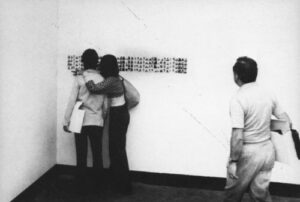
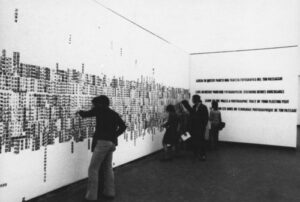
From this time on, Vaccari started a series of real-life interventions which he called Esposizioni in tempo reale, in which he used video and photography in order to document various kinds of happenings as they took place, often provoked by Vaccari himself. During the Venice Biennial of 1972, he displayed the invitation to the public to stick a photo of themselves on the wall with his Lascia su queste pareti una traccia fotografica del tuo passaggio (“Leave a photographic trace of your passing on these walls”). This was the fourth of his Esposizioni in tempo reale, and the artist’s first appearance at the Venice Biennial (though he was to return in 1980, 1993 and 1995). His work appears to tie in very closely with a number of the more recent fields of artistic research.
Vaccari has always coupled his artistic activity with theoretical reflections, publishing books such as Duchamp e l’occultamento del lavoro (1978) and Fotografia e inconscio tecnologico (1979), works which to this day constitute an important contribution to the theoretical debate on photography.
A special web-project about Franco Vaccari: WWW.VIRTUALGALLERY.FOTOMODO.COM (Homepage/Artists Directory).
Photogallery