Going Public ’05/1
Communities and Territories
LARISSA CONTEMPORARY ART CENTER
Progetto a cura di: aMAZE cultural lab
Idea e direzione artistica: Claudia Zanfi
Organizzazione: LCAC
Opening
Larissa Contemporary Art Center,
Thessaly, Greece.
21 Maggio/ 30 Giugno 2005
Urban interventions, workshops, films, debates
Press Release
Communities and Territories
1°) Contemporary Art Center, Larissa (Greece)
21 MAGGIO/ 30 GIUGNO 2005
Interventi urbani, workshop, film, dibattiti
Coordinamento Roula Palanta, direzione CACL
Arrivato alla sua terza edizione il progetto GOING PUBLIC (nato in parallelo al Festival Filosofia) vede la necessità di una crescita e di un ampliamento oltre i propri confini. L’edizione 2005 analizzerà il tema urgente della Nuova Europa, in particolare attraverso i flussi di persone, di economie e di culture dall’Est all’Ovest, e viceversa, a partire dalle teorie di De Certeau e Baumann. Il progetto sarà strutturato in più sezioni: laboratori sul territorio con gruppi locali (giovani, anziani, immigrati, ecc); realizzazione di opere d’arte appositamente per l’evento(fotografie, video, inteventi urbani, performance), dibattiti pubblici, rassegna di film, pubblicazione di un libro sul tema trattato.
Due importanti appuntamenti fanno da cornice alla ricerca del 2005: una prima fase del progetto si svolgerà a Larissa, in Tessalia (Grecia), su invito della città, per l’apertura di un nuovo Centro di Arte Contemporanea. COMMUNITIES and TERRITORY è il titolo della prima sezione di lavoro, che vedrà artisti italiani e internazionali impegnati in vari laboratori sul territorio ai confini con la Macedonia, con una presenza di autori dei paesi dell’ex- Jugoslavia. L’intento è di fare luce sulla vita in territori di confine con l’area balcanica, sulle migrazioni e i flussi della gente, sulle attività delle piccole comunità residenti a Larissa – snodo di passaggio tra Est e Ovest- , ma provenienti dall’ampio bacino balcanico e dall’est europeo (rom, vlachos, rifugiati dall’Asia Minore, dalla Russia, Albania, Serbia, ecc…), La seconda parte avrà luogo in autunno a Modena, con focus sulle regioni del Baltico, ed artisti dal centro-est Europa.
GOING PUBLIC si struttura fin dalla sua origine, come un laboratorio di ricerca, con l’intento di avviare genuine collaborazioni tra i partners. La sua natura è sperimentale e di ricerca su argomenti di grande attualità (mobilità, confini, geografie, la nuova EU, i futuri assetti economici e culturali, ecc..). Going Public è fin dalla sua origine un progetto che non si esaurisce in un solo evento, ma che resta attivo nel corso dell’anno: incontri, presentazioni in varie istituzioni europee, dibattiti, pubblicazioni, realizzazione di materiale video poi diffuso in sedi internazionali, ecc…
Dopo l’edizione precedente (da Gibilterra a Cipro), GOING PUBLIC’05 intende tracciare un’asse di scambio e di flussi dai Balcani al Baltico.
L’evento è in collaborazione con: Città di Larissa, dipartimento Cultura; Università di Volos – Facoltà di Architettura, e Facoltà di Antropologia; Centro per la Musica e la Danza di Larissa; Biblioteca Pubblica di Larissa; Cinema Olympia; Radio Agrotica; Prigioni di Stato di Larissa; Comunità Rom di Larissa; Comunità di Farkadona; Città di Trikkala; Deste Foundation; Comprensorio della Tessalia e della Macedonia.
ARTISTI: Maja Bajevic (Bosnia), Pablo Leon de la Barra (Mexico/London), Fabiana de Barros (Brasil/Swisserland), Gianmaria Conti (Italia), Nikos Charalambidis (Cyprus), Chaves+Mantilla (Colombia/Spain/Perù), Hariklia Hari (Greece), Maria Loizidou (Cyprus), Nomads&Residents (NYC/ Rotterdam/ Rome), Adian Paci (Albania), Maria Papadimitriou (Greece), Personal Cinema (Greece), Alexandros Psychoulis (Greece), Marietica Potrc (Slovenia), Rirkrit Tiravanija (NYC/ Bangkok), Vangelis Vlahos (Greece).
Dibattito:
Yorgos Tzirtzilakis (Greece); Carlos Basualdo (Argentina/USA); Marti Peran (Spain); Jerome Sans (France); Michelangelo Pistoletto (Italia).
Progetto speciale: LOVE DIFFERENCE, primo ufficio all’estero in collaborazione con Going Public. Presentazione di Filippo Fabbrica, direttore artistico Fondazione Pistoletto.
L’evento è ideato dall’associazione culturale aMAZE lab,
promosso dal Centro Arte Contemporanea Larissa e dalla Provincia di Modena.
Con il patrocinio di:
– DARC (Roma)
– Ministero Beni Cutlurali (Roma)
– Fondazione Adriano Olivetti (Roma)
– Regione Emilia Romagna (Bologna)
– Fondazione Pistoletto (Biella)
– Connecting Cultures (Milano)
– DESTE Foundation (Atene)
– Ministero Beni Culturali (Atene)
– Progress Foundation (Danzica)
– Art and his Time Foundation (Varsavia)
OPENING DAY – sabato 21 maggio 2005
10.00am
“Communities and Territories”
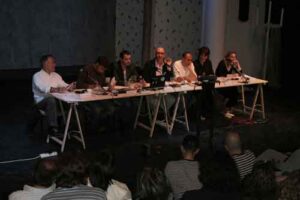
Dibattito al Milos Theatre con:
Yorgos Tzirtzilakis (Greece), curator + professor Volos Universtity
Carlos Basualdo (Argentina/USA), curator + co-director Documenta XI
Pistoletto Fondation (Italy)
Marti Peran (Spain) curator + professor Barcelona University
Jerome Sans (France), director Palais de Tokyo
introduce :
Claudia Zanfi (director MAST- Museum of Social and Territorial Art)
Roula Palanta (director LCAC)
03.00 pm “Music Moving Procession”
Art parade in the city (Pablo Leon de la Barra)
Philellinon Street (Maria Papadimitirou)
St. Velisarious Square (Fabiana de Barros)
University Library of Medicine (Nomads&Residents)
Panagouli Street (Hariklia Hari)
Train Station (Gianmaria Conti, Maria Loizidou, Raimond Chaves)
Pinios River (Alexandre Psychoulis)
Screening at the Kinitron gas station, N.Road Larissa-Trikala (Maria Papadimitriou)
Open-air Cinema Milos Screening (Maritica Potrc, Adrian Paci, Maja Bajevic)
Milos (Rirkrit Tiravanija, Personal Cinema, Nicos Charalambidis, Vangelis Vhalos, Alexandros Psychoulis)
09.00 pm “Dinner and Party” Music, food, talks, dance, open air party at Mylos, with surprises….
SUNDAY 22 MAY 2005 – h.12,00 Workshop: LOVE DIFFERENCE at Katsigras Municipal Gallery with the Foundation Pistoletto, held by Filippo Fabbrica (artistic director Pistoletto Foundation).
WENSDAY 25 MAY 2005 – h.21,00 Lecture: Visions of Thessaly, by Fotini Margariti (architect, Volos University) at Milos Theatre.
INFO + IMAGES:
aMAZE lab:
info@amaze.it
Contemporary Art Center:
ikastiko@otene.gr
ph. +30-2410-254577, 257353
Texts
by Claudia Zanfi
In 1968 Al Hansen, one of the leading figures of the Fluxus movement, stated that “in order to meet people, you have to think up new kinds of art like ‘food-art’”. Happenings, Situationism, Performance, right up to the so-called Relationship Art all came into being not far from the Fluxus movement. Numerous examples of these expressive phenomena were to be found in the recent Manifesta and Documenta Biennials in new forms and guises, thus demonstrating the ongoing reactivity of contemporary performance art.
Rirkrit Tiravanija is undoubtedly one of the key protagonists of these events. A multifaceted and multiform artist as reflected in his own roots: born in Argentina (in Buenos Aires), he grew up in Thailand (in Bangkok), and is now resident in New York and Berlin, travelling widely for much of the time. His travels, banquets, meetings, publishing and exhibiting projects (most recently at the Venice Biennial with his “Utopia Station”) clearly bear the signs of having inherited from Fluxus the notion of ‘non material events’, no longer bound up with the traditional concept of the objet d’art.
This way of experimenting with situations people and urban areas through the places familiar to the artist, using often minimal even simplistic gestures, constitutes a journey into the space of relationships, of common shared experience.
As the artist himself states, “I see everything as an important experience, as a work of art structured in an unorthodox manner. Who is to say how a work of art is structured, or where it starts and ends? My only desire is to be myself and to get this message across. That we have done something special together and yet at the same time very simple: we have shared a moment of our lives. Here, nothing is under control. I do not direct anything; everything happens of its own accord. I see the workshop as a kind of ‘meeting point’, a moment in which people meet and things happen. I am nothing but one of the many passengers on the boat.”
What really made Tiravanija famous were the cooking sessions for all and the ‘instant food’ project, conceived as works of art featuring great banquets organised inside galleries and museums around the world. The value of hospitality (typical of oriental cultures) and of the slow passage of time (typical of the works of Borges and his Latin roots) along with the transgression and desecration of the work of art: these are the ingredients needed to dismantle the neurotic framework of contemporary art.
For Going Public ’05 in Larissa, Tiravanija has created a new installation. A soft orange floor (the color of buddism) over which lay down and relax, watching Tv transmissions: a collection of meetings and talks, realized at “Portikus”, Contemporary Art Center.
Tiravanija himself describes his sculptures and installations as models. He often creates stages, platforms or spaces that can be understood as offers to the exhibition visitor.
Between the skylight and the floor, redesigned by Elmgreen and Dragset for the previous exhibition, the TV session shows a large platform which served as a stage for a variety of projects. The program included concerts, panel discussions, workshops, cooking battles, fashion shows, film presentations, and bar and dance nights. All activities were broadcasted live by the online channel “oVer Channel”, created by Tiravanija, and can now be followed via web at www.superchannel.org.
by Pablo Leon de la Barra
Art should not only be about creating aesthetic objects referring only to themselves or to the history of art, but about how groups or individuals can give visibility to that which affects them in order to help us better understand and transform our world. Still, when reality has such a presence it is not enough to document or give visibility to the forces of social, political and economical inequality and injustice. If there is any role to be played by art as a social mediator it consists on how to articulate and engage with the other members of society. The aesthetic act is needed in order to re-calibrate relations within otherwise fragmented societies. It is then that art uncovers its potential as a tool for social, cultural and political change and exchange.
However, questions continue to exist that need to be answered if art is to continue engaging with the social and political realities of a determined context:
1. How to engage with those that exist outside of the world of art without exploiting, exoticising or aestheticising them?
2. How can art production continue to belong within the aesthetic realm without being only denunciation, representation or documentation?
3. How can these tensions be reconciled, while recognising that the artist is not a social worker, a charity, or a politician?
1. El Cerro Museum
Puerto Rico 02, M&M Proyectos, October 2002
During ten days in October 2002 I lived in El Cerro, an informal settlement part of a Naranjito, a small village located one hour from San Juan, the capital of Puerto Rico. Chemi Rosado, an artist from Puerto Rico, had been working in El Cerro during one year, painting with the community the facades of the houses in different shades of green. The art project served to integrate the community in a town confronted with social problems including small scale drug trafficking as a strategy of economic survival.
During the time there, I visited the houses of El Cerro asking the inhabitants for objects that were significant to their personal or community history that could be borrowed in order to form part of the collection for El Cerro’s Museum to be located inside the abandoned Community Centre. The objects on loan, documented the triumphs and dramas of daily life in El Cerro, and ranged from the historical to the personal, including family photographs, decorative paintings, personal documents, sport awards, plants, furniture and music. The Museum gave the possibility to the inhabitants of El Cerro to negotiate their own history and visibility among themselves and the visitors to the Museum.
2. Chabola
Monasterio de la Cartuja, Sevilla, May 2003
In February 2003 I visited Sevilla to do a site visit to the place where the seminar “De Lo Mismo A Lo De Siempre: Informal Strategies in the Occupation of Public Space” would take place. The seminar would happen in May 2003 and within it I would build an Information Centre/Discussion Platform to be used by the event’s participants. My original idea was to build a space that would be an abstraction of the aesthetics of informality of Mexico City. During the days I was in Sevilla I followed in the newspapers a story about an illegal settlement of Rumanian gypsies living under the Patrocinio Bridge who were being dislocated and their house being demolished by the city’s authorities. I visited the place where I found a series of particularities: 1. the construction technique, materials and aesthetic of the houses was similar to the ones found in informal settlements in Mexico; 2. I was being invited to Sevilla to talk about informal strategies in Mexico, when in Sevilla there existed similar situations which were being eradicated and which ignored at least four decades of practice and research on how to deal with informal settlements. After visiting the settlement and talking with the inhabitants I invited them to collaborate and work with me in the construction of the Information Centre/Discussion Platform, celebrating their construction knowledge, a knowledge that I didn’t have.
When I returned to Sevilla in May, a week before General Elections, the settlement had been totally destroyed, including the houses of those who were in Spain legally. The Rumanians had been displaced and were nowhere to be found. The Information Centre/Discussion Platform then took the form of a “Chabola” (name given to shanty houses in Spain) and was built with the remains, found on site, of the Rumanian settlement. The newspapers with the history of the disappearance of the Gipsy Settlement were exhibited on site.
3. Pablo’s Jogging Tour
Localismos, Historic Centre, Mexico City, June 2004
Mexico City’s Historic Centre (a.k.a. El Centro) was once the centre of urban, social and economical life of the city and the site where the Spanish conquerors founded their capital over the Aztec city of México-Tenochtitlan. The Centre had been suffering continuous deterioration since the early XX century when it had been abandoned by the elite. Today, the Fundación del Centro Historico, is determined to change El Centro’s fate. With an initial investment in 2004 of over $300 million U.S. dollars and a long-term regeneration plan, the Fundación bought 70 buildings in El Centro to be converted into housing units in order to start the centre’s gentrification. In return, the City’s government has invested in urban infrastructure, introduced a new police force, installed high security closed circuit cameras, and been displacing and relocating the street sellers. Fundación del Centro Historico was also one of the main sponsors of Localismos, a residential workshop in which a group of 20 international artists, worked for a month in the centre of Mexico City producing works in dialogue with the context. The presence of the artists within Localismos was seen as an asset by the Fundacion, who understood that contemporary art is one of the determinant factors that ensure an areas gentrification.
It is in El Centro where historical identity is imposed by the elite and where this identity is challenged by the occupation of space by those in less privileged positions. While the elite sees and defends the Centre as a place where it can access past history, for the lower classes the Centre is the place that provides immediate access to the commodities, lifestyle and information of late capitalist modernity in the form of pirate CDs, DVDs of recent Hollywood hits, and clothing and accessories of fake brands like Armani, Tommy Hilfiger, Gap and Louis Vuitton. Jogging Tour exemplifies the battle for the use of private and public space in the City’s centre: while avoiding street sellers occupying the sidewalks as a way of economic survival, the parcourse of Pablo’s Jogging Tour visits selected moments (monuments) of resistance to the Historic Centre’s gentrification, including families in the risk of eviction from their buildings most of them appropriated when they lost their houses during the earthquake of 1985.
4. Songs for Larissa: Moving Musical Procession
with the collaboration of Larissa’s Philharmonic Municipal Orchestra, Director Maestro Jorgos Minas,
Going Public’05, Larissa, May 2005
1. Serenade: a song or the performance of a song used to court somebody, traditionally sung by a man in the evening outside a woman’s window. Also called serenata
2. From the list of songs played by Larissa’s Municipal Philharmonic Orchestra, ask the members of the band what songs they would like to play to the city of Larissa. From the list of songs, ask myself, what songs would I like the band to play.
4. Select 5 to 10 of these songs.
5. Select 5 to 10 public places in the city of Larissa. Select them because they are places of urban or social conflict, because they are abandoned, because they are iconic or representative of the city, because they are where certain groups live there, because they are special, because they need love etc.
6. During a day take serenade to the different places singing the selected songs: a moving musical procession crossing the city of Larissa from one edge of the city to the other.
Songs played by Larissa’s Municipal Philharmonic Orchestra:
1. Love Story by Francis Lai (at Milos/Larissa’s Contemporary Art Centre)
2. Beautiful Maria of my Soul by Robert Kraft (at Maria Papadimitriou’s Motel at Filellinon Street)
3. My Way by Francois (at Fabiana de Barros Peripeton at St. Velisarios Square)
4. Never on Sunday by Manos Hadjidakis (at Larissa’s Postal Square)
5. What a Wonderful World by George Weiss and Bob Thiele (at Larissa’s Railway Station)
by Martí Peran
These notes are nothing more than some preliminary remarks aiming at approaching a series of complex problems that, from our point of view, need to be recognized within the new, fashionable, artistic practices, which are dedicated to the exploration of their public dimension through the direct contact with local communities, and they operate in specific socio-cultural contexts. In fact, each one of these points forms a sort of index of subjects that should be delineated and expounded with the utmost tenacity but, for the time being, these points may serve as a guide for some subsequent analysis. Therefore, like a disorderly collection of ideas, we are going to throw the dice without distinction.
1.
A recognized aesthetic tradition, of positivist character, concedes to the artist the special capacity to circulate, through his work, an efficient expression of the “genius loci”, of the specific character of the place or, even better, of the hypothetical “essential spirit” of the place in question. From this perspective, the artist, even the “genius”, doesn’t construct an extravagant and alien to the majority imaginary but, on the contrary, he converts himself to the most legitimized voice to express and represent several essential attributes of a community, even though this community may not be initially capable of recognizing them in the aforesaid representation. This pretension, which is full of conceit, now hardly can be supported. Nevertheless, even if this happens by unexpected and barely conscious ruptures, something from this tradition may still be surviving.
In the world of globalized art and, above all, of art like a felicitous instrument for the aggrandizement of the spectacles of consumption, we are witnessing an explosion of biennials and disparate events that, in many cases, are planned with the view of “normalizing” the locations in which they take place. Cities that hardly exist on the map, either on national, continental or global scale, aspire to appear in it with the impetus of the artistic event. Similarly, places that are extremely well-known, because of their “problematic” nature though (the case of Tijuana or, mutatis mutandis, of the Basque Country in Spain) also resort to art, aiming at a regeneration –or a make-up– of the aforesaid problems, regardless of how honest are their initial intentions. In both cases –either in the “inexistent” places or the “problematic” places– the artists are invited to intervene with their equipment of the best intentions, but at the same time they are compelled to move from place to place like savior nomads. “Save the place” could be a good slogan for the legitimization of the figure of a new errant artist who, pressed by the following commission, hardly can recognize a situation, a reality or a community in order to apply to it his own strategies, before moving to an other area of the planet. Clearly, the artist “engaged” with the place and its people, doesn’t arrive in principle with a desire of manipulation or Messianism; on the contrary, he is supposed to have a sufficient humility and honesty, so as to respect the idiosyncrasy of the place of operations; but this very respect, along with his capacity as an occasional agent, he facilitates this automatic adoption of his habitual “modes of action”, to the extent that already relies on his already proven efficacy. After all, the “artistic” nature of the intervention appears once more as crucial, even though now its ingenuity isn’t found in its supposed capacity to reveal an essential background but, quite the opposite, in its capacity to contribute to the construction of a new image that, in fact, has little to do with real tensions. Moreover, the supposed “genius loci”, we shouldn’t forget that, is nothing more than the narration that aspires to impose itself as hegemonic on behalf of better established ideological sectors.
2.
In the first idea that we have outlined, contemporary art appears like a kind of a “sanitation protocol”. And this holds good, for in order to by-pass this danger we have stressed some corrective strategies: action in concert with other social agents of the place, which are alien to the world of art, accentuating a type of action that should be directed from the local users themselves, or development of some projects in co-ordination with the axes of the so-called “network aesthetics” (facilitating thus the horizontality in the construction of signifiés, multiplying the crossings of subjects and information and substituting every desire for stability, in favor of some “products” that are subject to constant change), even if we don’t need the literal mediation of the Internet. All these, as we were saying, can effectively make up for the dangers of what in the name of art ends up designing a distorted image of the place and its real demands and expectations. Because this is precisely the real problem: the clarification of the order of things. In other words, what comes first? Could it be the engagement through an effective insertion in a territory, or the necessity to guide this insertion in order to become more “legitimate”? Over the last few years the notion of “agency” has been imposed, with huge success, as a possible response to this disjunction. Indeed, the displacement of artistic action towards agency allows the elimination of every spark of the artistic and, consequently, annihilates any temptation to emancipation with the assistance of art. Agency, in principle, is nothing more than the offer of a possibility, the activation of instruments with which the community can channel in an effective way its imaginary or its real demands; in this manner, the art of “agency” is converted to an authentic production of services that always appears “behind” reality or, even better, appears only in connection with some real and pre-existing demands that, at best, use the “artistic” in order to empower and amplify themselves. Having reached this point, the conclusion is obvious: an agency cannot be articulated in any territory, but has to be articulated where this agency is demanded by real life. Consequently, the nomad artist of the global circuit will not be able to operate as an “agent” in the context of any biennial or event to which he is invited, but only where, behind the institutional invitation, exists a living world that, probably, is about to be eliminated behind the curtain of this very “resort to culture”.
3.
The last note that we would like to offer to this debate belongs to a level distinct from the one on which we were allowed to focus by previous problems. We may now put forward a reflection excessively abstract, but we have already recognized the preliminary character of these notes, and thus we can allow it to ourselves, at least, as an annex of sorts.
What we are interested in now is the recognition a possible paradox that is hard to be solved: the one that derives from the encounter between the action that is concerted with a specific territory or community and the necessarily “distorting” profile of authentic nomadism. In fact, we can suppose in principle that the artistic practices that are directed to the real conditions of a place/community aspire to cure with efficacy the deficiencies that can be recognized (a lack of visibility, the demands that need new instruments for their channeling, the unraveling of a potentiality that is stifling in pre-established structures) and, lastly, a series of horizons that demand a peculiar state of attention and listening. Furthermore, we could summarize them by calling upon the notion of “genius loci”, even if now this is done with a heterodox manner, reinstating thus the original notion of expression. It could be formulated either way, but the artistic practices with which we are preoccupied now –the mode of agency included– require a kind of initial passivity, or even objectivity, in the approach of the place, which allows us to recognize the context of operations with the least possible distortion and with the greatest disposition to the initially less visible. The contemporary artist, however, because of his condition as a nomad agent, which either results from the expansion of the world of art or, at best, it is the consequence of the historic condition that compels us to construct daily our subjectivity and to maintain a an always vulnerable relationship with the territory, in every kind of work-related or emotional vicissitudes; because of this very nomadism, the artist in question is converted to distorting reflection of the image of any place from which he passes through. It is, in effect, the authentic “nomadology”; it is the one that converts subjects –just because it is in a perpetual state of transit– to perturbating elements, to apologists of the un-quiet, thwarting every temptation to lessen the realities below any solid narrative. The story constructed by the nomad always is a story that “infects” the place that writes it and, consequently, we can suspect that in this way it would be hard to “sanitize” territories, not even with the intervention of the strategies of agency. It is nothing more than a superficial doubt, a paradox that may not be propounded in the best of ways, but we believe that it has an adequate draught that compels us to always remain in a state of alertness when we aspire to redirect art to the heterogeneous space of the public. This disjunction compels us to take a position on whether we should prioritize the effort to contribute to the uncovering of this heterogeneous and volatile condition or, merely, the effort to exercise it in order to construct one more episode of this infinite story. In that case, the connection with any place/community becomes suspicious.
by Angela Vettese
(…..) Therefore the artist does not have a theoretic place to stay: he’s forced to be a nomad in concept, condition that underlines and strengthens the chance of life for which Paci, emigrating from Albania, is also a deserter from his country. The relation of loss of the country, actually with his dose of uncertainty towards the new rules to follow by heart and respect, is analogue in everyday life like in the conception of art.
In a notorious video one of the two daughters of the artist sings an Albanian songs.
From a different screen, opposite and lower down, the relatives left in Albania, are echoing with love to a child that, maybe, they will never see again. And maybe soon, she will forget of these first elements of her culture of origin.
(….) This vagabond state, that from the personal sphere slips in the disciplinary and vice-versa, has found an expression even more synthetic and efficient in the series of images in which Paci is shown with an upside-down roof on his shoulders. The roof is the conventional one, with the red tiles, the same every child draws and we imagine when we think of a house. But the artist puts it on his back as if they were a pair of wings, upside-down; so it is no longer a roof for protection, for resting, for staying, but it becomes an excellent sign of the effort, of going, of the attempt that contemplates the possibility of mistake.
by Claudia Zanfi
For the third international edition of the GOING PUBLIC project, the main theme under discussion is that of the New Europe, as seen through the flow of peoples, economies and cultures from East to West – and vice versa – starting with the theories of De Certeau and Baumann. This multi-level project is based principally on collective urban artistic research, with workshops across the territory held together with local groups (the elderly, students, immigrants etc.) featuring works of art created especially for the event, together with film shows and a public debate on the theme in hand.
Two important events set the scene for the 2005 research. The initial stage of the project took place in Larissa, in Tessalia (Greece), hosted by the town itself, during the opening of the Contemporary Arts Centre. Communities & Territory is the title of the first section of the work, which has involved international artists in a variety of territorial workshops near the border between Macedonia and Albania. The aim was to shed light on life in those areas bordering on the Balkans, on the migratory flows and the activities of the small communities to be found in Larissa – a key point of passage between East and West – which originate from the whole Balkan area as well as eastern Europe (Roms, Vlachos, refugees from Turkey, Russia, Albania, Serbia, etc.… ). The second part will take place this autumn in Modena, Italy, focusing on the Baltic regions, with artists from central/eastern Europe. After the previous edition of GOING PUBLIC (from Gibraltar to Cyprus), the aim this year is to trace a vertical axis from the Balkans to the Baltic region.
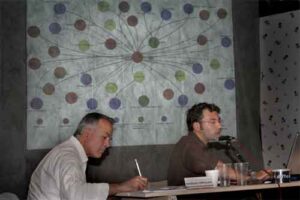
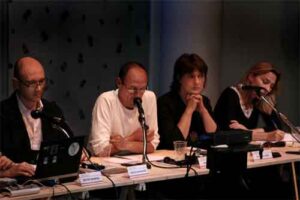
The relationship between community and territory, between city and citizens lies at the heart of all the most recent debates. The preoccupation with both urban and rural order, social policy and territorial management by common cultural denomination were debated in a public meeting in Larissa, with contribution from Carlos Basualdo, Marti Peran, Yorgos Tzirtzilakis, Filippo Fabbrica (there with first “Love Difference” workshop abroad for the Fondazione Pistoletto). As well as the artists, the meeting was also attended by the students of Architecture and Anthropology at the University of Volos. The provocation launched by the Going Public projects is based on an analysis of these motivations, of the counterpoising of administratively bureaucratic models of territory and community management on one hand, and the use of public spaces in living culture, through the social customs which the inhabitants nurture in their day to day lives on the other.
Carlos Basualdo opened with an important intervention on the need for interdisciplinary approaches, collective works, not one-off but long-term projects, for constructive institutional relationships, for interventions which make a clean break with the cultural activities of the 1970s, when many artists shunned all forms of mediation with institutions, museums and galleries. Territory is not a place but an action! Basualdo’s attention focuses on spontaneous intervention, on the revaluation of so-called “popular culture”, the transformational or rather revolutionary processes.
Marti Peran believes that transformation now takes place through the cultural projects which can be shared and “used” by local communities. He is openly in favour of participatory and public activities. Yorgos Tzirtzilakis re-elaborates several of Bourriaud’s theories on “relational aesthetics”, on the exploration of the possibilities offered by human relationships, interpersonal exchanges, and social interaction. In his opinion, the “community” is that which is “common”, just as – according to Agamben – the only true value lies in the common man. Thus it is the community itself which creates the sense of territory.
There is a clear notion of the need for works to be participated in and not simply looked at. With this in mind, the participation of Rirkrit Tiravanija and his new installation project in Going Public ’05 is fundamental: a soft orange floor, a TV station and an archive of “experiences” collected in collaboration with the “Portikus” Centre in Frankfurt.
Considerations on immigration imply a concept of State, of territory; they mean shedding light on that which risks being left in the dark. Among the various projects created for the event, special attention should be given to the research project carried out by Hariklia Hari entitled Post Programmed City-Territory. From topography to social form. An ex military base, with shipping containers to be used “in emergencies” (earthquakes, floods, etc…) at the beginning of the ‘90s, after the collapse of the USSR became a base for Russian immigrants. To this day, this community of “Pontians”, despite the various promises made by the local authorities, live inside the shipping containers in a state of degradation, social exclusion, an “exception state”.
And it is these ““exception states” which constitute the primary research element of the entire Going Public project. As the works of the various artists on show demonstrate, raising this kind of criticism is clearly very important today: mapping the Rom district and show the existence of a new city within Papadimitriou; from the divisions to the dialogue, which still characterise the Island of Cyprus in the works of Charalambidis and Loizidou, to the gathering of personal data and memories in Conti’s “Memory Box”; from the structure of Vlahos’ prisons to the “War Game” of Personal Cinema; right up to the spontaneous interventions in urban spaces by Pablo Leon de la Barra, Fabiana de Barros, Chaves & Mantilla and Marietica Portc.
Exploring the multi-faceted and unexpected ways in which public spaces may be exploited, documenting transformations, safeguarding the minimum levels of social interaction, and enacting artistic and cultural practices which interface with the city and its inhabitants. These are the themes which make the Going Public project effective and relevant, and which translate both the artistic experience and the observation of the participants into the language of common and contemporary communication.
by Michelangelo Pistoletto / Filippo Fabbrica
“Starting out from the idea of the sea that bears the name Mediterranean we extend the concept of love Difference to planetary level, broadening our vision to other “Mediterranean Seas” of the world. Each of these gathers historical and contemporary realities of different cultures around its shores which are related to different countriers. The name Mediterranean has a meaning common to all seas surrounded by land, as opposed to oceans and expanses of water without defined perimeters.”
Michelangelo Pistoletto, Progetto Arte – Journal 9, Fondazione Pistoletto Onlus ed, Turin 2005.
Communities and Territories.
One day micro workshop for the opening of the first Love Difference office in Larissa for Going Public’05, with an interdisciplinary group of artists, critics, writers, for the creation of a common vision about artistic projects and creative paratices concerning a way of responsible trasformation of society.
The workshop intends to move and experiment, analysis and critics on contemporary art works. Using the practice of learning by doing, meetings will be held before and after the opening of the “Communities and Territory” project, in order to fully articulate the critical processes that will derive from the encounter with works and presentations.Through these meetings, interviews and presentations the group will develop the following abilities: group dynamics, self-criticism, change of point of view. This represents a first step of activities for the territory and the community of Larissa.
The new Love Difference initiatives (1) come under a polycentric structure of activation. Three different centers are opened in Italy; site-specific projects has been promoted in different Mediterranean countries; co-operation with artists for action and organisation; research and invistigation.
Love Difference mission is to increase the comparison about actual social issues and to promote the intercultural dialogue through creative projects which are connected with social context.
Filippo Fabbrica, Love Difference project co-ordinator
Note (1)
Activation of Love Difference Centres:
– Querini Stampalia Foundation in Venice, by Chiara
Bertola, inserts Dafnà Moscati’s project called “Mediterranean in your city”.
– Southeritaghe Foundation, Matera. Being based on the organisation of a workshop on creative processes, proposals include projects for a responsible transformation of society.
by Claudia Zanfi
Contra la hamburguesìa transnacional papa criolla y tamal.
Contra la lògica del misil resistencia civil.
Contra la guerra total no violencia local.
So opens the section dedicated to the project by Raimond Chaves and Gilda Mantilla in the Going Public ’03 book. A large poster held up by demonstrators waving red flags against globalisation and all forms of repression.
Reflecting and making others reflect on the delicate equilibria between economics, art, politics and culture – with continuous reference to Latin America – is clearly one of the main aims of Chaves and Mantilla’s work. In their hands, art becomes a clear and direct means by which to make the state of the world more understandable. Chaves and Mantilla’s work focuses principally on an in-depth analysis of various social phenomena to be found in popular neighbourhoods (barrios) among common people, minority groups and the socially disadvantaged.
The barrio provides a flexible platform from which to gather data through interviews, drawings, photographs, stories, song and dance sessions, posters, flyers, newspapers, civil pressure groups. Everything that can be elaborated, discussed and developed to bring about “creative improvisation” is instrumental in the diffusion of local cultures and communities through the voices of the inhabitants themselves, the common people. This is a grassroots technique which operates among the hidden-most folds of social politics, and which draws out parallels and ties between art and popular movements, social protest and criticism of the ruling hegemony.
From the barrio, the pair’s interventions spread out to the key points of the urban fabric: the streets, the corners of the squares, yet public spaces are each adopted for their specific characteristics, not simply as performance stages. The artists’ favourite places in which to communicate with the public are those of a temporary nature set up in zones of passage. Chaves and Mantilla’s aim is not simply a question of highlighting that which is scarcely visible or hidden, but rather one of tapping into the process of transforming local culture and society. If anything, the artists seem to take on a vital role in the transformation of a fast-moving society. Once the line between political intervention and culture has been blurred, art is free to flourish through experimental communities, through the creation of new forms of representation, becoming more direct and participatory.
This is the basis of the HANGUEANDO project (a name taken from “hanging around”): a travelling project which gathers together the group’s experiences with the general public. With the use of their moveable platform – Estaciòn Movil – the two artists create a temporary research base which allows their participants to tell their own stories and interact collectively. Raimond Chaves and Gilda Mantilla thus create a space in which to interface with the public and put together a collective art project.
For the “Going Public ‘03” project, they set up a workshop dealing with the local setting with local people using the provincial railway network of Modena (several stages of this work were documented in the video presented at Larissa). People’s own stories transcribed onto paper, along with photographs both of the people interviewed and other people at the railway station were all posted on the walls of the station and published in the project’s newspaper on the platform.
This publication was the outcome of a workshop project carried out with the station employees, the railway workers, taxi drivers, train drivers, ticket office workers and commuters. Thus a wide range of people linked to the theme of mobility and commuting took part in the project, recounting their own experiences, their memories, their adventures – or sometimes misadventures – of life.
Through this kind of project, the creative process is brought back into contact with the city and its inhabitants. Suffice to say that over 1,300 people use the provincial railway network of Modena every day. Of these, 60% are students, 30% workers, and 10% pensioners. Of these, %12 are non-European immigrants. Traditionally, these categories of people live in different areas, often distant from one another. A project which leads them to come together as a whole in the station hall and take part in this sort of collective activity represents a remarkable opportunity for cross-cultural meeting and integration.
Hangueado aims to constitute a real territorial research workshop allowing for a type of open, grassroots approach which gives space to a range of points of view and which focuses on collective living in the urban context with a view to understanding its newly emerging structures, while valorising it and opening up new spaces for discussion.
by Carlos Basualdo In collaboration with Reinaldo Laddaga
It is perhaps ironic that a discussion of what could possibly be defined as a new culture of the arts should begin with a contemporary incarnation of that old modernist saw, the toilet. Yet, the toilet in question is very different from the one that Marcel Duchamp presented almost a century ago at The Society of Independent Artists. In 2003, the Slovenian artist Marjetica Potrc, in collaboration with the La Vega neighborhood association, and the Israeli architect Liyat Esakov, proposed the installation of two dry toilets –literally, toilets that do not requiere water to function– in Caracas and its outlying areas. Potrc initiated her work a a research project involving several “barrios” or shanties of Caracas without a specific goal in mind, mainly interested in developing the tools that would allow her –and her eventual audience- to understand the life-conditions in those extreme urban conditions. As Potrc wrote in communication with the authors: “I was personaly drawn by the fact that the barrios are not planned, they are self-upgrading structures…” “Liyat and me realized that the infrastructure provided by the city has failed the barrios; electricity is generally stolen and water is provided to the barrios only twice per week.” After an initial stage of research that lasted three months, during which many discussions with members of the local community took place, Potrc and Esakov decided to focus on a project that would address the sewage contamination and the scarcity of water that plagues the inhabitants of the “informal city” –as shanties are technically called. Again in her own words: “I decided to focus (and test my ideas about) on infrastructure, self-upgrading and small-scale approach. Barrios are self-upgrading structures themselves , and the dry toilet is supposed to be a device that can be built by residents themselves.” The construction of a prototype of a toilet that could be built and used in the neighborhood followed. The first “dry toilet” was intended to be tested for a six-month period –after which it may be adopted by the area’s residential complex. The process also included the design of forms of display of the documentation of the process, in order to exhibit the prototype and the social exchange that led to its creation. This project in fact represents the climax of a long period of Potrc’s work devoted to the search for solutions to a number of concrete cases of extreme need.
Potrc’s work is a perfect example of the growing importance in the field of contemporary art of a number of artists whose projects involve participants outside the traditional realm of the visual arts. These artists eschew making self-sufficient stable objects that are removed from the particular physical or social context in which they appear. They do not produce specific events or performances confined to a particular place or time, but rather, they propose open-ended projects aimed at fostering an experimental community: a temporary but durable association, composed of artists and non-artists who come together to create a specific project and who coalesce as a coherent, if impermanent, entity through their mutual endeavor. This involves the construction and occupation of physical spaces, the exploration of the social relationships that emerge as an effect of the group’s association and the creation of narratives and images. The latter are designed to circulate within the collective that originated them and within the open collectivity of potential spectators of the art world. These projects demand the mobilization of complex artistic strategies that combine techniques traditionally related to the arts with technology and the mass media.
Potrc, for example, uses drawing to explore a range of urban problems that attract her attention and to investigate a variety of possible solutions, both realistic and utopian. Reminiscent of Yona Friedman’s sketches from the 1970s, her drawings seems to perform a pedagogic role, informing the art audience of the developments of the artist’s activities when these take place outside the traditional exhibition spaces. Combining words and images, her drawings bridge the apparent gap between her urban investigations and a more established definition of artistic practice. Potrc usually complements these drawings with a related web site and the display of various experimental prototypes and utilitarian objects. These “power tools,” as she calls them, are both paradigms for–and embodiments of–a wide range of already existing “solutions” to specific social problems. The “solutions” are not instrumental in the productivist sense. They do not belong, for instance, to the progressive tendency of “formalizing” the disorganized or “informal” aspects of a particular impoverished neighborhood by integrating it into the macro-economic urban system. Instead, Potrc adopts partial and economically sustainable “self-help” solutions, which contradict the instrumental and bureaucratic logic that subordinates individual subjectivity to supposedly objective criteria of efficiency. Potrc’s “solutions,” then, are only solutions insofar as they restore the autonomy of those who adopt them.
Like Potrc, a number of artists have generated strategies that take up certain moments from the neo-avant-garde tradition and develop them in innovative ways. The relationship between these newer practices and the work of an artist like Joseph Beuys or the activities of a group like Situationism can be compared to the one that exists between contemporary movements for global justice and the political revolts of the ‘60s and ‘70s. The latter rallied around the figures of national or social liberation in the context of industrial capitalism and privileged a model of revolutionary transformation. The former opposes the dominant neo-liberal consensus by proposing forms of administering common resources whose objective—to quote historian Immanuel Wallerstein– “is performance and survival rather than profit.” In a similar way, the artists under consideration here maintain a commitment to non-hierarchical collaborative production, while rejecting the tendency to see art as a manifestation of authentic experience or pure matter, which persisted in these antecedents and explains their propensity to ritualism.
One of the most well known ( ) examples of these practices was Thomas Hirschhorn’s installation at the most recent Documenta. The piece involved the construction of a series of precarious buildings, called Bataille Monument (2002), in the public spaces belonging to the Friedrich Wöhler-Complex, a number of residential buildings situated in the north of Kassel. The project included a sculpture of wood, cardboard, tape and plastic; a library of books related to Georges Bataille (a collaboration with Uwe Fleckner); an exhibition made in collaboration with Christophe Fiat featuring a topographic rendering of Bataille’s work –a large, trimendionsional map that portrayed his work as a territory waiting to be explored–,; various workshops developed with Manuel Joseph, Jean-Charles Masséra, and Marcus Steinweg; a television studio broadcasting daily on the Kassel public-access channel; a stand with food and drinks; a shuttle service to bring visitors from Documenta and to ferry neighborhood residents to the larger exhibition; and, finally, a website with images from live cameras distributed in the various “buildings” that constituted the fragmentary totality of the Monument. The Bataille Monument intended to house and present a number of simultaneous projects and activities in order to activate a particular community –the residents, mostly immigrants families of Turkish origin, of the Friedrich-Wöhler Complex– but also to secure a space of exchange that would allow that community to enter into new forms of dialogue with a larger context, including other communities in Kassel, the city administration, and the audience of Documenta. The process of constructing the piece itself constituted the invention of a both a model and apossible community––a community that, while composed from certain pre-existing elements, will have as its goal the effective incorporationof people, places, and ideas that were initially foreign to it.
At first, Potrc’s and Hirschhorn’s activities might seem familiar as forms of state sponsored community art or as projects of art education. However, both these strategies are essentially conservative insofar as they conceive of artistic production as a compensatory activity while, at the same time, they generally imply a static notion of communities –that are themselves actually dynamic. Projects like Hirschhorn’s, by contrast, take place in contexts where the very existence of the participants’ fixed identity cannot be assumed. Indeed, the premise of works like Bataille Monument is that all identities–even the most putatively stable ones–are inexorably volatile.
Such projects set out to increase the complexity of certain urban and social situations through the incorporation of heterogeneous elements from their surroundings. The work thereby adjusts itself to its milieu and creates a space in which the knowledge and actions that arise from its making can circulate and be recorded. These projects attempt to explore the potential for aesthetic pleasure that is derived from such a process of collective learning. In these projects, groups of artists and non artists engage in designing how to execute a certain endeavor while deciding on how to articulate its goals and the identity of the collectivity concerned. These are truly open processes, both in terms of allowing for the contingencies that occur while they are being undertaken and in the sense of being permeable to new members.
This type of community building through learning was central to Jeanne van Heeswijk’s Face Your World, a collaboration between the Wexner Center for the Arts, the Central Ohio Transit Authority, and the Greater Columbus Arts Council’s Children of the Future program. The project allowed a group of children aged six to twelve to produce images of their urban surroundings by using computer software (installed inside a bus), which was developed by the artist in collaboration with the poet and philosopher Maaike Engelen and the Rotterdam software designers V2 Organisation, Institute for the Unstable Media. The collection of personalized images of imaginary public spaces that resulted were displayed on three “bus stops,” which were in fact slightly anthropomorphic public sculptures designed by another van Heeswijk collaborator, Dutch artist Joep van Lieshout and his Atelier van Lieshout. Face Your World was not intended to reconstruct the actual city but rather to imagine the very possibility of doing so. Above all, it created the potential for collective invention and community building.
Potrc’s, Hirschhorn’s, and Van Heeswijk’s projects start with an affirmation of the primacy of collaborative production processes over individual ones. Where a large number of individuals with access to different types of knowledge converge, a degree of complexity emerges that is out of reach for individual artists. This condition allows for the creation of a radical constructivism, a practical conception of the social by which a human group takes form through learning processes carried out by means of sustained conversation among its members. Such a process occurs in Cybermohalla, an ongoing project in New Delhi begun in 2001 by Sarai: The New Media Initiative of the Centre for the Study of Developing Societies. Cybermohalla comprises a group of Indian artists, filmmakers, and computer experts who work in collaboration with Ankur, a non-governmental organization dedicated to experimental forms of educational. The project sets up meeting places for young people and assists them in carrying out collaborative activities that usually take the form of interviews and annotations in hypertextual diaries, later submitted for public discussion. Shuddhabreta Sengupta, a member of Sarai, writes: “Diaries have the potential to evolve newer languages that further displace dominant discourses because they are situated and personal, outside of the domain of the ‘expert,’ and the technocratic language, that ‘expertise’ entails.” The interviews, stories, photographs, software animation, and audio recordings that make up the diaries have been made public via books, postcards, CDs, stickers, monthly magazines, and a multimedia installation evocatively titled Before Coming Here Had You Ever Thought of a Place Like This.
Similarly, beginning in 1993 in the St. Pauli district of Hamburg, another hybrid project brought together a series of exhibitions, ongoing conversations, and celebrations in a mutually reinforcing circuit. That year, an alliance of neighborhood people, musicians from the local Pudel Club, and squatters started a protest to keep the city government from giving an important lot, which was a meeting place for the different populations of the area, to private developers. When some artists, including Christoph Schäffer, Cathy Skene, and later Margit Czenzi joined the effort, they formalized a complex multidisciplinary venture under the name “Park Fiction” –the name is derived of a rave that took place at the beginning of the ‘90s in Hamburg, while at the same time stressing the relevance of the imagination in the production of effective social change. Together they proposed an urban plan to the Hamburg city government, as well as a series of activities to be carried out jointly by the neighbors and the members of the group. These endeavors were aimed at giving an actual manifestation to the desires and knowledges which were specific to the St. Pauli neighborhood, while contributing to the formation of a community that depended on otherwise unlikely alliances. Some of the activities were topical, such as the workshops, tours, film screenings and lectures that the group called “infotainment.” Others were ongoing and took place every day in a specially modified shipping container that the group set up in the vacant lot; there, a series of items associated with the project, such as archives and communication media, were housed. A third initiative involved a touring exhibition, which appeared at the Vienna Kunstverein in 1999 and at Documenta 11, and will open at the Centro Andaluz de Arte Contemporáneo in Seville this May. There, documentation related to “Park Fiction” is shown in an installation designed by architect Günther Greis that evokes the constructivist language of the Soviet avant-garde. When the first phase of the park was finally built in September 2003, artist groups including Sarai and Argentina’s Ala Plastica visited Hamburg for “Unlikely Encounters in Urban Space,” a series of presentations that took place over several days and ended in a collective celebration.
The projects discussed above involve the construction of environments in which artists and non-artists come together to produce representations and communities. For these artists, the main question is to avoid the temptation to identify and merge with a community, understood as authentic and organically defined, which characterized many earlier community projects. And thus, to break away from the sacrificial figure of altruism. The artists in question are familiar with a certain tradition of modern and contemporary art, that they intend to extend and reactivate. This tradition includes figures such as Hélio Oiticica, Gordon Matta-Clark, and Robert Smithson–artists for whom artistic practice consisted less in executing an a priori plan in their work than to develop the capacity to respond directly to situations in the outside world beyond the subject’s control. While drawing on this outward focus, artists today are more reliant on institutional frameworks and support to promote and ensure the long-term success of their projects. Art institutions constitute a network of relatively connected environments, thereby offering experimental communities an opportunity to reach one another, as in the case of Hirschhorn’s project at Documenta. Nevertheless, artists today still demonstrate an ambivalent relationship to these institutions, which are implicitly limited in their social efficacy by their tendency to exhibit objects more or less in isolation for more or less solitary individuals for relatively brief periods of time.
In all these projects, as anthropologist Arjun Appadurai has written, “internal criticism and debate, horizontal exchange and learning, and vertical collaborations and partnerships with more powerful persons and organizations together form a mutually sustaining cycle of processes.” The concern is to facilitate the creation of exchange networks between groups of people in order to produce new representational forms and community identities. In turn, these circuits come to intervene in traditional art spaces, thereby effecting a “globalization from below.” And for this reason these projects constitute various components of a certain universe in the making, one characterized by the vast movement and interaction between far-flung social networks. These art projects involve social movements aimed at both local empowerment and global connectivity through the re-appropriation of expert knowledge by specific communities. In the process, these organizations find themselves inexorably faced with a fundamental problem: modes of organization. How are very diverse local intentions brought together in more or less unified actions that acknowledge their diversity as well as their shared values? How are positions in a broad conversation distributed and enumerated? Suddenly, these problems have become central for artists working collaboratively with communities. Is it possible for the arts to intervene effectively in the shaping of contemporary society? Recent community based artistic projects are raising precisely these questions while at the same time attempting to answer them.
Artists
Untitled, 2001- 2005 (Video Demo Station no.1)
4 DVD’s, each 1 hour and 45 minutes long, PAL, stereo audio, color.
The project is a new installation created by the artist for Going Public ’05. It is a collection of experiences, realised putting together many different situations of collaboration and sharing with public: from typical cooking sessions, to musical moments, to public debats.
In collaboration with Portikus, Frankfurt.
DVD 1.
– Opening
with Darren, Consume Bar and Null Runde
Friday, April 6th, at 8 pm
DVD 2.
– Cooking Battle
Thomas Bayrle vs. Rirkrit Tiravanija
Wednesday, April 18th at 8 pm
– Cooking Battle
Tobias Reheberger & Christian Zickler vs.
Sebastian Stohrer & Phillip Zaiser
Wednesday, May 9th at 8 pm
DVD 3.
– Plex
Music feat. Anja Czioska & Matthias Vatter in concert
Wednesday, May 9th at 9 pm
– Digital Edge in Concert
Thursday, May 17th at 9 pm
– Vivienne in concert
Wednesday, May 16th at 9 pm
DVD 4.
– Seminar on the white cube and contemporary exhibition.
Models hosted by Rebecca Gordon Nesbitt & NIFCA (nordic institute for contemporary art) with Michael Elmgreen and Ingar Dragset, Daniel Birnbaum, Rirkrit Tiravanija and others
Friday, May 18th at 3 pm
IN.4 B.
interrelations for beasts, 2005
The project is a case study on the cattle-breeders of Thessalian plain. Traditionally most of the cattle-breeders of Thessaly have their origin from Sarakatsianaioi race, they were nomads who follow a circular route based on the season’s changes.
There is an architectural interest in the way they structure the ephemeral lodgings of their flocks.
In collaboration with Thessaly University, Department of Architecture, Volos.
THE MAKING OF BALKAN WARS: THE GAME, 1999-2005
The project primarily focused on the social and cultural issues within the Balkan Peninsula and on the creation of a network between artists, art critics, writers from South eastern Europe. It presents media works created by the 50 participating artists that investigate the Balkan territory and way of life. Both geopolitical war games and epic strategy video games are interrelated in this multi-media project.
In collaboration with 50 international artists.
COMMON GROUND. HOTEL GRANDE, 2005
A workshop on the concept of “ground and mobility”: union of people, territories and common places. A multi-level project with 2 rooms’ hotel, installated in Old Market area. The hotel function as a rest place for travellers and nomads, with reception and bedroom. Travellers are also invited to attend to film projections at Gas Station Kinitron, on the road to Farkadona. The work is completed by mapping a new carthography. An Atlas with ten categories of public spaces define new approches to the city: public buildings, hospitals, schools, transportations, religion, culture, economy, etc….
In collaboration with Thessaly University, Department of Architecture, Volos;
Rom Community of Larissa.
COMMON ARCHIVE, 2000-2005
Nomads & Residents makes connections with people who live in a certain place and with people who visit, by setting up an active network of collaborators, and creating and organizing public events in a variety of places.
In collaboration with University Library of Medicine, Larissa
TRANS-KID, 2005
Workshop with kids from schools in the cities of Nicosia and Larissa. The children, aged from 8 to 11, where asked to create their own drawn on the subject of “territory”. The project develops an installation with matterrass and pillows, typically used during travels and refugee camps. They are the “first aids objects” from which people can start to image their exterior habit.
In collaboration with Primary Schools in Cyprus; Karavana School in Larissa; Train Station, Larissa.
Post Programmed City Territory.
Farkadona Case, 2005
Workshop at Farkadona Trikalon, where there is a community of repatriated Greek Pontians and Armenians refugees. Is located at the edge of Farkadona City, at an existing military camp infrastructure, to which were transported prefabricated containers (previously used by the earthquake victims of Kalamata). The demand of the community is to move to “real” houses as promised by the state on their arrival.
In collaboration with Thessaly University, Department of Architecture, Volos; Farkadona Community; KEP Office, Prefecture of Larissa.
THE MEMORY BOX, 2003-2005
The Memory Box is the container for everyone’s stories. Is a free space, mobile and territorial. Is fed by accounts connected with a specific neighborhood, city or province, and travels directly to where people live and work. Is made for people, with the people. Everybody is invited to enter and tell stories about his own life. Is a station encounters between personal experience and the great episodes of History.
In collaboration with Central Station, Larissa;
The Memory Box is design by Bauhaus University, Weimar.
KIOSK OF CULTURE, 2005
A project of common experience and multi cultural function, where the kiosk reveals all his potentials: Tv station, place for workshop, for communication, for meetings. The people are invited to use the kiosk, and they are directors of their own knowledge and of their references. Therefore, the Kiosk of Culture is perpetually on the point of creating and reinventing itself.
In collaboration with Dimitris Masouras.
Buildings for Correction, 2005
The project is a case study on the second toughest prison in Greece located in Larissa territory. It focuses on the morphological and architectural elements of the building, with models presenting the prison’s current shape, a found model borrowed from the prison director’s office and an archive of images (found in local newspapers) detailing visually the building’s structural changes.
In collaboration with National Prison in Larissa.
SOCIAL GYM no.223
The Tupperware Show at Military Camp, 2005
The artist works on a stratificated level of symbolism and actions. The project emphasizes on the impact of militarism since his childhood in Cyprus. According to the hybrid style of the local architecture of Larissa (elements like Chinese pagoda are often presents in the territory) the soldiers are asked to construct a bunkded for their new military sleeping chamber. The use of tapperware in many military and refugee camps, will be transformed in a monument – a wall – in Nicosia for Manifesta 2006.
In collaboration with Larissa Military Airport.
ESTACION MOVIL, work in progress
Video, pal, color, sound, 14’, 2005
ESTACION MOVIL is a moving platform, a space for interaction with the public, designed for workshops. It takes place in a train stations or local communities. Estacion Movil is an artistic activity using a wide range of media, from drawing sessions to photo-portraits of travellers; from stories told and written, then hung on the wall in the station. The project usually ends with a publication “Hangeando” (Hanging around) the first paper to be compiled exclusively by the users and commuters.
In collaboration with Central Station, Larissa.
Women at work, 2000
Video, color, sound, 12’
Vajtojca, 2003
Video, color, sound, 4’
In praise of dry toilet, 2003
Video, color, sound, 5’
All three international artists work on concept of territories, communities, sharing of experience, memory and culture.
Photogallery